
Diversity of Leadership Seminar
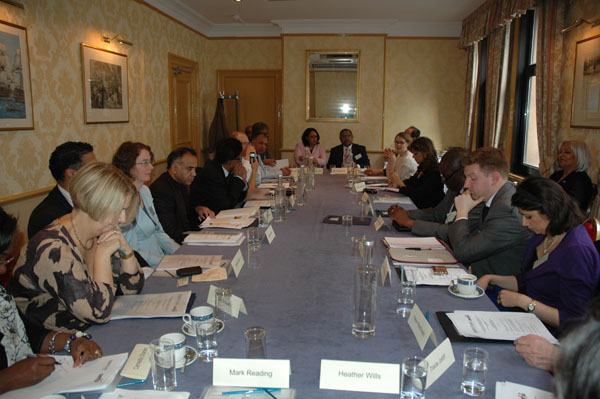
Basildon Council held a roundtable debate on increasing the diversity of leadership in the public sector on 31 March 2011, hosted by CEMVO, at the Civil Service Club
Baroness Verma, Minister for Equality and Women, and Bala Mahendran, the CEO of Basildon Council, chaired a roundtable discussion on the very low level of senior appointments in the public sector for the BME communities as well as women on the whole. The debate was conducted under Chatham House rules and the main points highlighted were:
- The glass ceiling is like a concrete ceiling where only 0.8% of BME’s make to the senior management level in the public sector which, in total, employs 5 million people. For instance, even the ethnically diverse councils like Leicester and Bradford have no BME person in a senior leadership role; Brent has one and is the only borough a little more successful in implementing a diversity leadership policy.
- Brent’s example improved only after a general study highlighted the problem of the ‘racial computer’ bias against non-European names in general and Brent then took action to ensure that the same bias would not happen at their Council. Since then their corrective measures have led to BME names being promoted to senior positions based on their merit.
- The first and second generations are softer but the third and fourth generations growing up now will rebel against any such prejudice. The reason why many Asians went into their own businesses is partly due to the lack of promotional prospects they faced however much they were qualified. It’s easier for them to promote their own businesses to their audiences. At trade-specific or demographic-specific marketing events, Asians could better succeed using trade show displays and focused marketing campaigns than they would trying to climb up the corporate ladder. Some get interviews for top jobs but in an ‘old boys’ network environment as soon as they see their face they write them off.
- There are systemic issues, how many Black football managers are there? Role models are few and far between; there is a visibility problem.
- Political leadership statistics are worse than career led leadership figures. Based on the studies, it is evident that political leaders must undergo leadership development programs just as corporate leaders do.
- How do you remove those who create the glass ceiling? Recruitment agencies have to sell to their networks; so they themselves can’t be blamed. Sometimes the sales order specifically requires an agent to source someone from the BME community just to comply with their diversity policy for someone who just about ‘fits in’ but won’t reach the top. This is an assimilation policy, not a diversity policy.
- We ought to put the business case that at the Board level diversity of opinions would make better decisions. We should not fall into the trap of ‘victim mentality. Diversity can actually deliver better results.
- Diversity is not only important; skilled and capable leadership with a peer advisory group can ultimately help a company grow exponentially.
As seen from the overview, this meeting seems to focus primarily on the public sector. Meanwhile, the private sector is making its mark through effective self-learning processes and community support. Since the early 2000s, setting up a business has become relatively easy regardless of industry or monopoly. As an example, an individual who wants to open a cannabis business may not face very difficult challenges since leadership programs and business guides (click here for such a guide) are readily available. There are also a number of business events and management programs for that individual that may be beneficial to the smooth operation of the company. Since it seems difficult for public sector companies’ leaders to have dedicated leadership programs, this diversity in leadership events is likely to have a significant impact.
Baroness Verma offered to take this up in her department and then have a follow-up meeting in about six months time.
{loadposition myposition-1565}
On behalf of CEMVO, Anil Bhanot thanked all the participants for their very valuable contribution to the debate and Baroness Verma for taking time out to hear peoples grievances on this very important issue and which he hopes will lead to perhaps a new Government policy in time to come. Bala Mahendran was passionate in his summing up all the key points and we are sure we will see a lot more of him leading such debates in due course. Finally, we mustn’t forget Dilip Joshi who has been the main driver to highlight the need to get greater equality in public appointments for the BME communities and it was Dilip who had approached CEMVO to host this debate, which we were privileged to do.
Anil Bhanot 21 April 2011


