
Kashmiri Refugees seminar for Parliamentarians
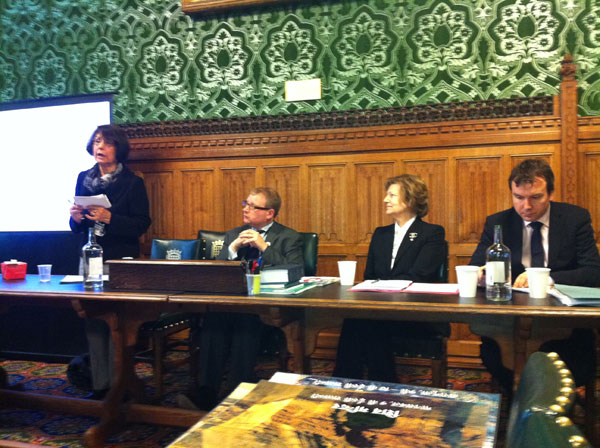 The Indo-European Kashmir Forum (IEKF) held a seminar on 30 March 2011 to discuss the plight of the Hindu and Sikh Refugees in Jammu, the Internally Displaced People (IDP’S) from the Kashmir Valley
The debate was chaired by Marcus Jones MP, with Baroness Emma Nicholson, a LibDem Life Peer and the Rapporteur of the Kashmir Report of 2007. The All Party Parliamentary Group for Kashmir was invited and their Secretaries, Andrew Griffiths MP and Richard Harrington MP, attended the debate.
Baroness Nicholson made the point that experience tells us that the IDP’s have now been refugees in Jammu for almost 20 years and with the new generation growing up there, they would have no appetite to go back to Kashmir. Therefore we should try and raise funds from the Business community to help raise their standards where they live rather than continue to ask for their return to their homeland. Baroness said that those people whom she met and their children have brilliant minds but the children have no real education or job opportunities but who simply would not want to go back to the valley. However they need our help now and where they have learnt to accept their home. She said that she was shocked that the Indian Government does not have a Policy on the IDP’s, and that since they do not have a policy there cannot be any resources put towards the welfare of these people. She said that is how Governments work, there must be a specific policy first on the IDP’s.
Krishna Bhan the President of IEKF gave a speech about the squalor the IDP’s continue to live in.
A presentation showed how after the famous (or infamous) speech of Benazir Bhutto in 1989 in which she declared that ‘Pakistan will never rest until it frees Kashmir from India’, every Mosque in Kashmir played the speech constantly on their loud speakers for three days. Every Hindu was told, ‘Convert, Leave or Die’, thus leading to the mass Exodus of Hindus in 1989/90 of ½ a million people.
Dr Surendra Sharma gave a political account of the Indian Government and the Opposition Parties in India being paralysed by the Western Governments financial support for Pakistan which does nothing to quell Pakistan’s political ideology over Kashmir and the terrorism that ensues across the boarder. He suggested rather than the financial aid for appeasement of terrorist activities the money should be targeted at reform in political ideology. He said at the partition Hindus and Christians were a sizeable proportion of Pakistan’s population and now they are negligible. He said that the political face of Islam has no place for minorities.
Shantanu Bhagwat, a former diplomat from Asaam, gave a presentation on the Article 370 which he said existed for all principalities after the Raj but it was a temporary measure, which Sardar Patel, the first Home Secretary of Independent India, annulled in all principalities except Kashmir, because then only Pandit Nehru, being a Kashmiri Pandit, was in charge of the Kashmir policy. The Article 370 obligates India to protect Kashmir but without any reciprocal arrangement on Kashmir to submit to India’s constitution, thus an Indian cannot even buy land in Kashmir, an Indian has no citizen rights at all in Kashmir. Art 370 is a legal anomaly which India continues to observe blindfold. He said that the Kashmir problem will remain until Article 370 is rescinded.
Krishna Bhan explained that Art. 370 should have been rescinded when Raja Hari Singh acceded to the Dominion of India on 26th October 1947 by signing the legal Instrument of Accession. However the UN’s involvement in the war scuppered that procedure. Further the UN issued a resolution for a Plebiscite referendum for the people of Kashmir to decide their future. Since then the majority went on a campaign to rid itself of all the minorities so that on a referendum there will be no opposing votes. Moreover there have been several recorded massacres of Hindu and Sikh people to the point of complete annihilation of the minorities in the valley. And of the final great exodus of 1989/90, there are still 70,000 Hindu families and 18,000 Sikh families living as IDP’s in slum conditions in Jammu.
Anil Bhanot was asked to speak on the Kashmir Ethnic Cleansing – and my speech is reproduced as below.
“To understand the current problems of Kashmir we need to go back and trace the history of Kashmir, if I may be allowed.
Kashmir is known as the fountain-head of Hindu spirituality. It was here that the first Hindu Rishis – Seers – connected with the all-pervasive, omnipresent Parmatma, the Hindu concept of God. As a result, for millennia, the entire Indian civilisation thrived under a spiritual base as opposed to a materialistic one. It was only at the beginning of the last millennium around 1000AD that an Islamist Mahmud of Gazni from Afghanistan invaded India that this finely balanced civilisation came to be challenged by a barbaric foreign ideology and which these people did not really know how to cope with. Mahmud Gazni brought with him a proselytising religion to convert people. The whole concept of proselytism of this new religion was alien to the spiritual base of India but Mahmud Gazni, through a policy of enslavement or death, managed to convert some of the tribal people around the valley, in Swat and further afield. After plundering and destroying temples all across India, it is alleged over 16 or 17 campaigns, he always went back to Gazni in Afghanistan. After his death the Hindu Kings resumed their rule over the valley again.
The Hindu King Harsha ruled in 1089-1101AD and he was not a good king. He too looted temples to feed his extravagance and not really knowing the political side of Islam he recruited some Muslim Generals from the Tribal areas in his army for their prowess. Harsha would have recruited them as valient men not as Hindu or Muslim but this was the way however that Muslims from the Tribal areas came to taste power and politics. This led to more Muslims coming to the vallley over the next century or so from abroad. Then under Suhdeva’s rule 1301-1320AD several missionary Muslims came to the valley, a noted one was Bulbul Shah in 1313AD. The Hindu king was welcoming as he did not know the political side of Islam, he simply thought it would be like the Hindu Kings in the past who welcomed Jews, Syrian Christians and Parsis, so he was simply keeping to the tradition of welcoming foreigners. He gifted the Muslims with jagirs, or land in the villages, just as in Kerala the Hindu King had gifted land to Jews in the BC era.
But soon after, a central Asian chieftain Dulucha invaded with 60,000 cavalry and defeated Suhdeva. This warlord Dulucha was however just following Mahmud Gazni and like him he also looted and enslaved people and then left, just after a year or so, but then leaving a power vacuum in the valley.
Then what happened is actually quite significant. A pseudo Buddhist Rinchana, from Tibet, took hold of the power vacuum and ruled the valley. Rinchana then tried to persuade the Pandits to accept him as their own but the Pandits rejected his plea saying that he is an outsider and cannot be a part of them. This was the biggest blunder the Pandits made and it shows how India’s birth based Caste system worked against it in the last millennium. In contrast during the BC era the Alexandra’s greeks who remained behind were accepted into the Kashtryia Caste as warriors. Rinchana ruled only for 5 years but this was enough time for the missionary Bulbul Shah to come and convert him first and scores of others to taunt the Pandits’ of their clannish purity. Bulbul Shah the Missionary had Royal Assent to convert the entire valley.
With the Muslim influence rising in 1400AD, a Sikandar, another bigot like Mahmud Gazni and Dulucha, was barbaric in his conversions. He gave three choices to the Pandits, convert, leave or die. The valley has never recovered from this ideology. Under Aurangzeb the Hindus were persecuted all over India, not just Kashmir, where the Hindu children were forbidden from education, even things like they could not wear shoes, some ridiculous fatwas.
But as the Sikhs had rebelled with sword they retook Kashmir in 1819-1846 and then with some other Hindu Kings and with a British protectorate peace and human rights were restored to the valley.
After independence in 1947 you all know the history of conflict with Pakistan and with the militants the same ideology of leave, convert or die as Raj Pandit explained for 1989/90 exodus seems to have continued. Their current separatist leader, Geelani, is now saying that he is against the secularism of India not the Hindus – well there are hardly any left – but he wants Islamic law enshrined in the state. The problem with their majority religious law is that non-Muslims and other minority Muslim creeds are given a Dhimmi status, of a second class citizen. It becomes the unwritten law despite their signing up the UN Charter of equal Human Rights. The Indian Muslims in other parts of India are also against what Geelani demands and if the Indian Muslims can live peacefully and successfully under the Indian secular constitution then a political solution is surely possible.”
{loadposition myposition-1564}
Andrew Griffiths MP and Richard Harrington MP were very sympathetic and supportive to the IEKF cause. They assured the UK organisations present that they shall visit the IDP’s in Jammu for themsleves and also the people in the valley, with the APPG on Kashmir, and then make recommendations.
Krishna Bhan thanked the Chair Marcus Jones MP for hosting the debate and all the speakers. She will for herself take a cue from Baroness Nicholson to find ways of working on raising funds for the IDP children’s education.
Anil Bhanot
16 April 2011


